
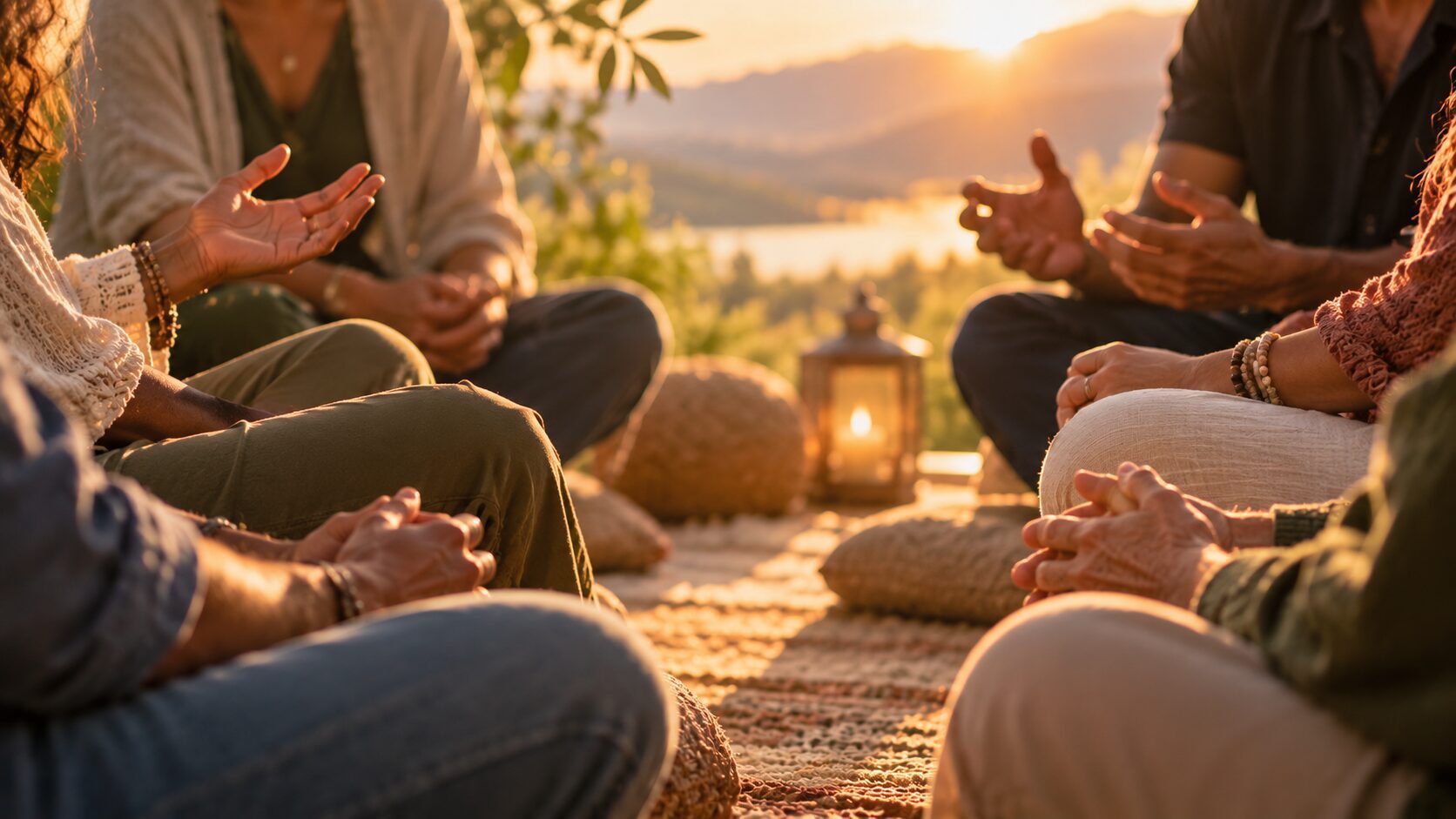
The Healing Power of Belonging
Why intentional community matters in a world that keeps us busy, guarded, and disconnected.
We live in a world that has never made it easier to communicate—and yet genuine connection can sometimes feel increasingly difficult to find.
Our days are full. We work. We care for families. We answer messages, manage households, keep appointments, tend to responsibilities, scroll through one another’s lives, and move from one thing to the next.
We may interact with people all day long and still find ourselves longing for something deeper.
Because contact is not necessarily connection.
There is a particular kind of nourishment that happens when we sit with other human beings in a space where we are not required to perform, impress, accomplish, explain, or pretend.
A space where we can simply arrive as we are.
And perhaps one of the great losses of our increasingly busy and individualistic lives is that we have fewer places in which to practice doing exactly that.
We Are Wired for Connection
Belonging is not a luxury.
Human beings have always gathered—in families, tribes, villages, circles, spiritual communities, around fires, around tables, in celebration and in grief.
We learn ourselves in relationship.
And yet relationship is also where many of us have been hurt.
We may have learned somewhere along the way that it wasn’t safe to speak freely. That acceptance depended upon behaving a certain way. That vulnerability could be used against us. That we needed to be pleasing, entertaining, successful, agreeable, quiet, strong, or useful in order to belong.
So we adapted.
We learned to protect ourselves.
Some of us became quiet. Some became funny. Some became caretakers. Some became achievers. Some learned to disappear in a room, while others learned to command it.
And beneath all of those strategies may be a very simple human question:
Is it safe for me to be myself here?
What Safe Community Can Teach Us
An intentional group gives us an opportunity to explore that question differently.
When people gather with a shared commitment to kindness, presence, respect, confidentiality, curiosity, and authenticity, something begins to happen.
We practice being seen.
We practice listening without fixing.
We discover that we can disagree and remain connected.
We learn that someone else’s experience does not have to threaten our own.
We discover that we can speak and take up space—and that we can also become quiet enough to make space for another.
For someone who experiences social anxiety, even entering a group can feel enormously vulnerable. The mind may immediately begin its familiar work:
What should I say?
Do they like me?
Do I belong here?
Am I talking too much?
Am I not talking enough?
What are they thinking about me?
But a healthy group can slowly become a place where we experiment with putting those questions down.
Instead of constantly asking, “How am I being perceived?”
we begin asking,
“Can I simply be here?”
That is a very different way of inhabiting a room.
And, eventually, a very different way of inhabiting ourselves.
From Protection to Presence
In the yogic chakra tradition, the root chakra is associated with safety, stability, grounding, trust, and belonging.
I find that symbolism particularly meaningful when thinking about community.
Many of us carry experiences that have taught our bodies and minds to remain watchful. Trauma, rejection, instability, abandonment, criticism, conflict, or simply years of not feeling fully accepted can leave us expecting danger even when none is immediately present.
Our nervous systems have extraordinary protective responses—fight, flight, freeze, and other survival adaptations—that help us respond when something feels threatening.
The difficulty comes when protection becomes our habitual way of moving through the world.
We may enter a room already scanning.
Who is safe?
Where should I sit?
What do they expect from me?
How do I protect myself?
Intentional community cannot erase trauma, nor is simply joining a group a substitute for therapy or appropriate trauma treatment.
But a thoughtfully held community can offer something deeply valuable:
repeated experiences of connection in which we are invited to remain ourselves.
Little by little, we may discover that we don’t always have to armor ourselves.
We can breathe.
We can stay.
We can speak.
We can listen.
We can belong.
The Courage to Be Known
I have intentionally gathered in groups many times throughout my own journey.
Some were spiritual. Some were therapeutic. Some were centered around learning, healing, meditation, or personal growth.
Again and again, I have found these experiences to be among the most supportive—and sometimes most challenging—parts of my own becoming.
Because authentic community doesn’t only comfort us.
It reveals us.
A group can show us where we withdraw.
Where we judge.
Where we compare.
Where we become afraid.
Where we want approval.
Where we struggle to trust.
Where we hide.
And, if the space is compassionate enough, we don’t have to condemn ourselves for any of it.
We can become curious instead.
Over time, I found that being in intentional community challenged me to become freer—to allow myself to be seen more fully, while also learning to make room for the full humanity of others.
Not everyone has to think like me.
Not everyone has to understand me.
Not everyone has to be like me.
And I don’t have to become someone else in order to sit beside them.
There is tremendous freedom in that.
Perhaps Belonging Is Something We Practice
We often think of belonging as something another person or group gives us.
They accepted me, therefore I belong.
But perhaps there is another layer.
Perhaps belonging is also something we learn to allow.
To belong requires that some part of us becomes willing to be known.
Not completely. Not immediately. Not without discernment and healthy boundaries.
But gradually.
We bring a little more of ourselves into the room.
We risk telling the truth.
We allow someone else to witness it.
And then we discover:
I am still here.
You are still here.
We are still connected.
That is how trust grows.
Not through forced vulnerability, but through many small experiences of safety, authenticity, and repair.
We Need Places to Be Human Together
Maybe this is one of the invitations of our time.
To create more spaces where human beings don’t have to accomplish anything in order to be worthy of being there.
Spaces where we can put down our phones.
Look into one another’s eyes.
Listen.
Laugh.
Reflect.
Sit quietly.
Tell the truth.
Learn something.
Share a meal.
Watch a movie.
Meditate.
Have a meaningful conversation.
Or simply spend an hour remembering that we were never meant to do all of this alone.
Community doesn’t require us to become the same.
Healthy community makes room for our differences while reminding us of something underneath them:
We belong to one another.
And sometimes, sitting in a circle with other human beings is enough to help us remember that we also belong to ourselves.
An Invitation to Gather
At Insights Wellness, I am continuing to create opportunities for intentional community—different kinds of spaces for reflection, learning, conversation, laughter, presence, and genuine human connection.
You don’t have to arrive polished.
You don’t have to know anyone.
You don’t have to be particularly outgoing or spiritual.
You simply have to arrive as you are.
Explore upcoming gatherings, wellshops, and community events at Insights Wellness →https://insightswellnesscenter.com/events/
BE • HEAL • BELONG.